Why Are There So Few Trash Cans in Japan? Reasons and Travel Tips
Why Are There So Few Trash Cans in Japan? Reasons and Travel Tips
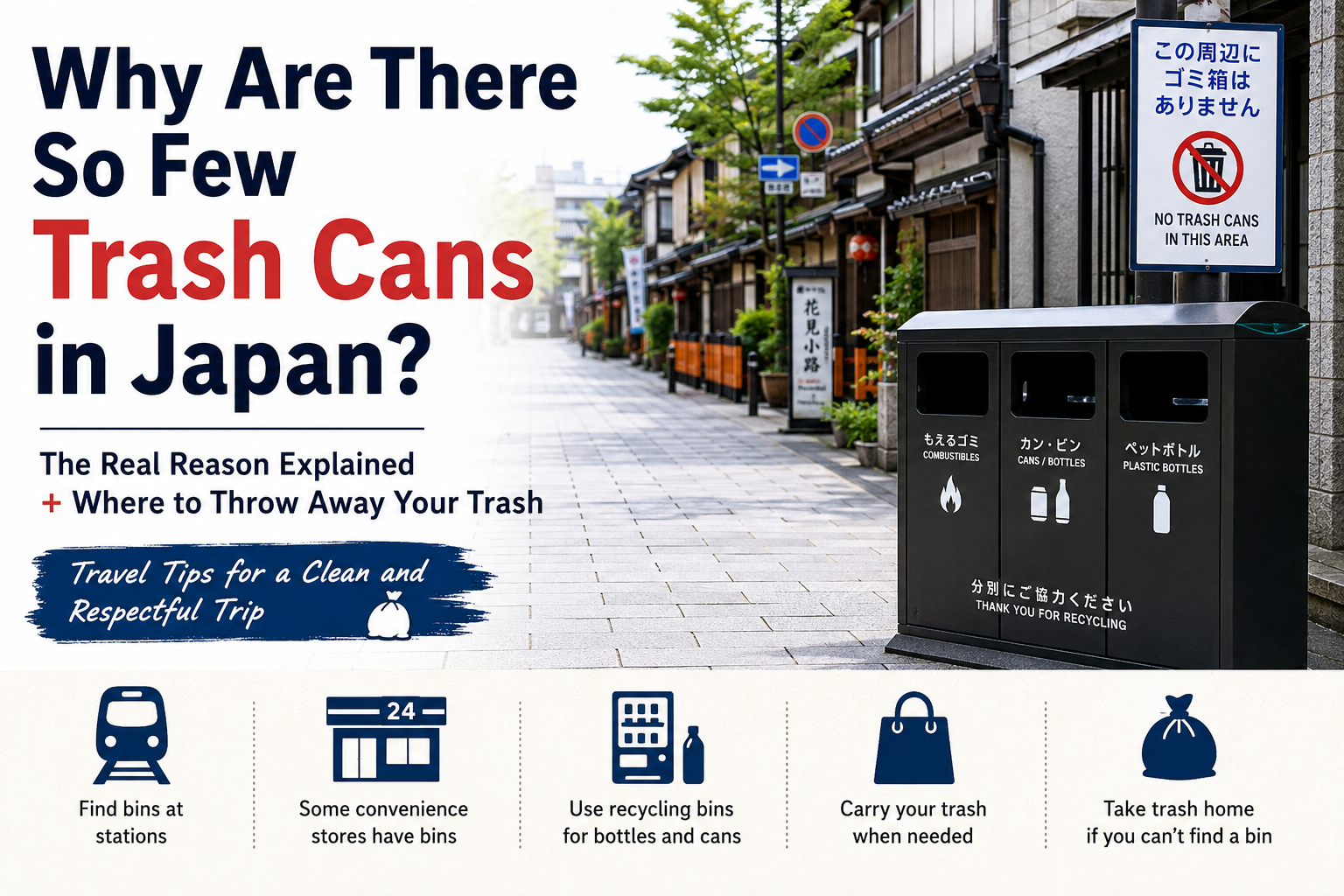
Why Are There So Few Trash Cans in Japan?
Visitors to Japan are often surprised by how difficult it can be to find a public trash can, even in busy cities and popular sightseeing areas.
There is no single reason for this. Security measures, the cost of collecting and managing public waste, local recycling rules, and the common practice of carrying personal trash until a suitable disposal point is available all contribute to the situation.
This guide explains why public trash cans can be limited in Japan, where travelers may find them, and what to do when there is no suitable bin nearby.
Quick Answer
Japan has relatively few public trash cans for a combination of reasons rather than one single cause. Security policies affect the way bins are managed in some transport facilities, while collection costs and detailed local waste-sorting systems also make public disposal more complicated. Travelers should expect to carry small amounts of trash until they find an appropriate bin at a station, shopping facility, tourist site, food court, or other designated location.
1. Why Does Japan Have So Few Public Trash Cans?
There is no nationwide rule requiring Japan to have fewer public trash cans. Instead, the number and type of bins vary depending on the operator, municipality, station, business, or tourist facility.
The limited availability seen in many places is best understood as the result of several factors working together: security, operating costs, waste sorting, and local policies.
1-1. Security Measures Affect How Some Public Bins Are Managed
Security is one important factor, particularly at railway stations and other high-traffic facilities.
Japanese railway operators have strengthened measures against suspicious objects, crime, and terrorism. Tokyo Metro, for example, states that it uses transparent garbage bins together with security cameras as part of its safety measures.
During major international events, visits by dignitaries, or periods of heightened security, transport operators may also strengthen security arrangements and restrict access to certain facilities.
The 1995 Tokyo subway sarin attack is often mentioned when discussing public trash cans in Japan, but it should not be treated as the single cause of today’s situation. Trash-bin policies differ between railway companies, local governments, businesses, and individual facilities.
Important context: Security concerns help explain why some stations use transparent bins or limit access to them, but they do not fully explain why public trash cans are limited across Japan.
1-2. Public Trash Cans Require Collection and Maintenance
Installing a public trash can also creates an ongoing management responsibility.
Bins must be emptied before they overflow, cleaned, inspected, and monitored for incorrectly sorted waste. Busy stations and sightseeing areas may require frequent collection, especially during holidays or major events.
For railway operators, businesses, and local governments, public bins therefore involve recurring labor and waste-management costs rather than only the cost of the container itself.
This helps explain why some facilities limit the number of bins or place them only in controlled locations where collection and sorting can be managed more easily.
1-3. Waste-Sorting Rules Vary Across Japan
Japan does not use one identical waste-sorting system nationwide.
Rules differ by municipality and facility, and waste may be divided into categories such as burnable waste, plastic bottles, cans, glass bottles, and other recyclables.
Some areas use even more detailed systems. Kamikatsu in Tokushima Prefecture, for example, is known for sorting waste into more than 45 categories as part of its zero-waste program.
For travelers, this means that the labels on a bin are more important than the color of the container. A recycling opening intended for plastic bottles or cans should not be used for food wrappers or general waste unless the sign specifically says they are accepted.
1-4. Littering and Tourist Waste Are Still Current Issues
Japan’s reputation for clean streets does not mean that littering has disappeared.
In 2026, Japan’s Ministry of the Environment continued a model program focused on reducing litter at tourist destinations, with particular attention to areas affected by inbound tourism.
This is important because it shows that public cleanliness depends not only on cultural habits but also on active waste-management policies, tourism measures, and cooperation from visitors.
Key point: Japan’s limited number of public trash cans is best explained by a combination of security policies, collection costs, local sorting systems, and facility-level decisions. It is not accurate to attribute the situation to a single historical event.
2. Why Are Japan’s Streets Still So Clean?
Visitors are often surprised that Japanese streets can remain relatively clean even when public trash cans are difficult to find.
There is no single explanation. Personal habits, rules at individual facilities, regular cleaning, waste collection systems, and education about shared spaces all contribute to keeping many public areas clean.
2-1. Carrying Your Trash Until You Find a Bin Is Common
When a suitable trash can is not available, carrying your waste until you find an appropriate disposal point is a practical and widely accepted response in Japan.
For travelers, this may mean keeping an empty snack wrapper, used tissue, or food container in a small bag until reaching a station, shopping facility, accommodation, or another place with suitable waste bins.
This is especially useful when visiting parks, temples, residential neighborhoods, or sightseeing areas where public trash cans may be limited.
Traveler Tip: A small sealable bag can be useful for carrying wrappers and other small items until you reach an appropriate disposal point.
2-2. Many Public Spaces Have Their Own Rules and Cleaning Systems
Clean streets are not maintained by personal behavior alone. Railway stations, shopping centers, tourist attractions, commercial districts, and other facilities may have their own cleaning schedules and waste-management systems.
Some facilities provide clearly separated waste stations, while others limit where visitors can dispose of trash. Cleaning staff and facility operators also play an important role in maintaining heavily used public spaces.
This means Japan’s relatively clean public environment is better understood as the result of both individual behavior and organized management rather than one cultural characteristic.
2-3. Students Often Help Clean Their Schools
One feature of school life that may surprise international visitors is that students commonly participate in cleaning their own schools.
Depending on the school, students may help clean classrooms, hallways, stairs, and other shared areas as part of the school day. Japan’s Ministry of Education, Culture, Sports, Science and Technology has described cleaning activities as part of the country’s school environment and educational activities.
These routines give children regular experience in helping maintain spaces used by other people.
However, school cleaning should not be treated as the single explanation for why Japanese cities are clean. It is more accurate to view it as one of several practices that can reinforce responsibility for shared spaces.
2-4. Japan Still Has Littering Problems
It is also important not to give the impression that littering never happens in Japan.
Popular tourist destinations and busy urban areas can experience problems with discarded food packaging, drink containers, cigarette waste, and other litter. Local governments and facility operators continue to introduce measures to deal with these issues.
Japan’s Ministry of the Environment has also supported projects aimed at reducing litter at tourist destinations, including measures connected with increasing numbers of international visitors.
In other words, Japan’s reputation for clean streets does not mean that cleanliness happens automatically. Maintaining public spaces requires cooperation from residents and visitors as well as ongoing work by local authorities, businesses, and cleaning staff.
Key takeaway: Japan’s relatively clean public spaces are supported by several factors working together, including responsible waste disposal, facility management, regular cleaning, local policies, and everyday experience with maintaining shared spaces.
3. Where Can Tourists Throw Away Trash in Japan?
Public trash cans can be difficult to find in Japan, but travelers still have several options for disposing of waste responsibly.
The most important thing to remember is that availability varies by station, store, facility, and location. Rather than expecting a public bin on every street, look for designated waste stations and follow the labels provided.
3-1. Train Stations May Have Trash and Recycling Bins
Some railway and subway stations provide trash or recycling bins, but travelers should not assume that every station will have them.
Depending on the railway operator and station, bins may be located near ticket gates, on platforms, or in other designated areas. Some stations use transparent containers or other designs that allow staff to check the contents more easily as part of security measures.
Availability can also change temporarily because of security arrangements, construction, maintenance, or decisions made by individual railway operators.
If you find a station bin, check the labels carefully before using it. Openings may be separated for newspapers, plastic bottles, cans, or other types of waste.
3-2. Convenience Stores Do Not Always Provide Trash Bins
Convenience stores are often mentioned as places where travelers can dispose of trash, but this advice requires some caution.
Some convenience stores provide waste bins for customers, either outside the entrance or inside the store. Others do not provide them at all.
Even when a bin is available, it should not automatically be treated as a public disposal point for waste collected elsewhere. Store policies and accepted types of waste vary by location.
If you have just purchased and eaten food or finished a drink from the store, use the designated customer bins when available and follow the sorting labels. If you are carrying unrelated waste and are unsure whether it is accepted, ask a staff member rather than assuming.
Important: A convenience store is a private business, not a public waste-collection facility. Do not leave trash at a store simply because you cannot find another bin.
3-3. Vending Machine Recycling Boxes Are Mainly for Drink Containers
Travelers will often see collection boxes beside vending machines, but these should not be confused with general-purpose trash cans.
The Japan Soft Drink Association refers to these as recycling boxes designed to collect empty beverage containers. Depending on the box, they may accept items such as PET bottles and cans.
Food wrappers, tissues, plastic shopping bags, takeaway containers, and other general waste should not be placed in these boxes unless the labeling specifically indicates that they are accepted.
Before using a recycling box, check the illustrations and wording on the container rather than assuming that any nearby waste can be thrown inside.
Easy rule to remember: A recycling box beside a vending machine is primarily for empty drink containers, not for everything you want to throw away.
3-4. Shopping Centers, Food Courts, and Tourist Facilities Are Good Places to Check
Large commercial and tourist facilities can be useful places to look for designated waste stations.
Shopping malls, department stores, food courts, museums, theme parks, airports, and major tourist attractions may provide bins for waste generated by visitors using those facilities.
Food courts in particular often have collection areas where trays, leftover food, cups, and packaging are separated according to the facility’s own rules.
However, availability is not guaranteed. The safest approach is to look for clearly marked waste stations and use them only for the types of trash they are intended to accept.
3-5. Your Hotel or Accommodation Is Often the Simplest Option
If you cannot find an appropriate disposal point while sightseeing, carrying a small amount of trash back to your accommodation is often the simplest option.
Hotels generally provide waste bins in guest rooms or designated collection areas. Some accommodations may also separate bottles, cans, and other recyclable materials.
Follow the instructions provided by your hotel, hostel, or other accommodation, especially if separate recycling containers are available.
For travelers spending an entire day away from their accommodation, keeping a small bag in a backpack can make it much easier to carry wrappers and other lightweight waste until a suitable disposal point is available.
| Location | What Travelers Should Know |
|---|---|
| Train stations | Some stations have bins, but availability depends on the railway operator and station. |
| Convenience stores | Some provide customer bins, while others do not. Do not assume outside waste is accepted. |
| Vending machines | Nearby recycling boxes are generally intended for empty beverage containers, not general trash. |
| Shopping centers & food courts | Designated waste stations are often available for customers, especially in eating areas. |
| Tourist facilities | Major attractions may provide bins, but availability varies by facility. |
| Hotels & accommodation | Often the simplest place to dispose of small amounts of travel waste at the end of the day. |
Best Advice for Travelers
Do not plan your day around finding a public trash can. Use clearly designated bins when they are available, follow the sorting labels, and be prepared to carry small amounts of waste until you reach an appropriate disposal point.
4. Common Mistakes Tourists Make When Throwing Away Trash in Japan
Most travelers want to dispose of waste correctly, but Japan’s system can be confusing if you are used to having public trash cans on nearly every street.
The safest approach is simple: use only clearly designated bins, follow the labels, and keep your trash with you when you are not sure where it belongs.
4-1. Do Not Leave Trash Beside a Full Bin
If a trash can is already full, avoid placing bags, cups, or food packaging on the ground beside it.
Waste left outside a container can create extra work for staff, attract birds or other animals, and make litter more likely to spread around the surrounding area.
Instead, keep the item with you and look for another designated disposal point.
Simple rule: If the bin is full, do not create a second pile next to it. Carry your trash until another appropriate bin is available.
4-2. Do Not Use Beverage Recycling Boxes for General Trash
One of the easiest mistakes to make is putting food wrappers or other general waste into a recycling box beside a vending machine.
These boxes are usually intended for empty beverage containers such as PET bottles and cans. They are not automatically general-purpose trash cans.
Tissues, plastic bags, takeaway containers, food packaging, and other waste should not be placed inside unless the label clearly says they are accepted.
When in doubt, check the illustrations and wording on the container before using it.
4-3. Do Not Assume Every Convenience Store Will Take Your Trash
Convenience stores can be useful places to dispose of waste, but not every store provides customer trash bins.
Some locations keep bins inside, some place them near the entrance, and others provide no disposal facilities at all.
Even when a bin is available, bringing in a large amount of unrelated waste from elsewhere may not be appropriate.
If you are unsure whether a store accepts your trash, ask a staff member rather than leaving it near the entrance or placing it in an unsuitable container.
4-4. Check the Sorting Labels Before Throwing Anything Away
Waste-sorting categories are not identical everywhere in Japan. A station, shopping mall, tourist attraction, or municipality may use different categories and labels.
For example, one collection point may separate PET bottles, cans, and general waste, while another may use different categories.
This is why travelers should avoid relying only on the color of a bin. Look for English words, symbols, pictures, or examples showing what belongs in each opening.
Best practice: Follow the label on the bin in front of you rather than assuming that waste-sorting rules are the same everywhere in Japan.
4-5. Empty Drink Containers Before Recycling Them
If you are disposing of a PET bottle or can, finish the drink before placing the container in a recycling box whenever possible.
Containers with a significant amount of liquid remaining can leak and make collection and recycling more difficult.
Some recycling stations may also provide a separate place to discard leftover liquid, but this varies by facility.
If no such option is available, keep the container until you can dispose of it properly.
4-6. Do Not Leave Trash at Shrines, Temples, Parks, or Residential Areas
Some sightseeing areas have few or no public trash cans. This does not mean that waste should be left on benches, walls, planters, or beside signs.
Shrines, temples, parks, residential streets, and scenic areas may rely on visitors to take their waste away when disposal facilities are not provided.
If you cannot find an appropriate bin, keep the trash with you until you reach a station, commercial facility, accommodation, or another designated disposal point.
Common Mistakes to Avoid
- Leaving trash beside a full bin
- Using beverage recycling boxes for food wrappers or tissues
- Assuming every convenience store accepts outside trash
- Ignoring the sorting labels on bins
- Throwing away bottles or cans with a large amount of liquid inside
- Leaving waste at parks, temples, shrines, or on the street
The Easiest Rule for Travelers
If you are not sure whether a bin is appropriate for your trash, do not force it. Keep the item with you and dispose of it later at a clearly marked waste station.
5. Practical Tips for Traveling in Japan Without Public Trash Cans
Once you know what to expect, dealing with trash while traveling in Japan is usually straightforward.
The key is to avoid assuming that a public trash can will always be nearby. A little preparation makes it much easier to explore cities, temples, parks, shopping streets, and other sightseeing areas without worrying about where to dispose of small amounts of waste.
5-1. Carry a Small Bag for Your Trash
One of the easiest ways to prepare is to keep a small bag in your backpack or day bag.
It can be used temporarily for snack wrappers, tissues, receipts, takeaway packaging, and other lightweight waste until you reach an appropriate disposal point.
A sealable bag can be especially useful for packaging that may contain crumbs, moisture, or odors.
Traveler Tip: You do not need to carry anything large. A small lightweight bag is usually enough for the waste generated during a few hours of sightseeing.
5-2. Use Designated Bins Where You Eat or Shop
When eating at a food court, café, fast-food restaurant, or other facility with a designated waste station, dispose of the waste generated there according to the facility’s instructions.
Some convenience stores also provide customer bins, although availability varies by location.
Using designated disposal points when they are available can reduce the amount of trash you need to carry later in the day.
Always check the sorting labels, especially when separate openings are provided for PET bottles, cans, food waste, or general trash.
5-3. Do Not Rely on Finding a Bin at Your Next Destination
If you are heading to a temple, shrine, park, residential neighborhood, hiking area, or smaller sightseeing spot, it is sensible to assume that a public trash can may not be available.
This is particularly useful when planning a full day of sightseeing. If you buy food or drinks along the way, be prepared to keep the packaging with you afterward.
Major stations and commercial facilities may provide disposal options, but availability should never be treated as guaranteed.
5-4. Check the Label Before Using Any Recycling Box
A container that looks like a trash can may actually be intended only for specific recyclable items.
This is especially common beside vending machines, where recycling boxes are generally provided for empty beverage containers rather than food wrappers or other general waste.
Look for words such as PET bottles, cans, or bottles, as well as pictures showing the items that are accepted.
If the label does not match the waste you are carrying, keep it with you and look for another disposal point.
5-5. Your Accommodation Can Be a Useful Final Option
If you still have a small amount of ordinary travel waste at the end of the day, your hotel or other accommodation may provide an appropriate place to dispose of it.
Guest rooms commonly have waste bins, and some accommodations provide separate recycling or collection areas.
Follow the instructions provided by your accommodation, particularly when bottles, cans, or other recyclable materials need to be separated.
For unusual items or larger amounts of waste, ask the accommodation staff rather than assuming they can be placed in a guest-room bin.
Quick Travel Checklist
- Keep a small bag for wrappers and other lightweight waste.
- Use designated customer bins when they are available.
- Check labels before using recycling boxes.
- Do not assume that every station or convenience store has a trash can.
- Be prepared to carry your trash during sightseeing.
- Follow the waste-disposal instructions at your accommodation.
The Bottom Line
Finding a public trash can in Japan can sometimes take longer than visitors expect, but it does not need to become a travel problem. Use clearly designated bins when available, follow local sorting labels, and be prepared to carry small amounts of waste until you find an appropriate place to dispose of them.
Frequently Asked Questions
Here are answers to some of the most common questions travelers have about trash cans and waste disposal in Japan.
Why are there so few public trash cans in Japan?
There is no single reason. The limited availability of public trash cans in Japan reflects a combination of factors, including security measures at some facilities, collection and maintenance costs, local waste-sorting systems, and decisions made by railway operators, businesses, municipalities, and other facility managers.
The 1995 Tokyo subway sarin attack is often mentioned in discussions about trash cans in Japan, but it should not be treated as the sole explanation for the situation across the country.
Where can tourists throw away trash in Japan?
Travelers may find designated trash or recycling bins at some train stations, shopping centers, food courts, tourist facilities, airports, convenience stores, and other commercial locations.
However, availability varies considerably. If no appropriate bin is available, keep the waste with you until you reach another designated disposal point or your accommodation.
Can tourists use trash cans at convenience stores in Japan?
Some convenience stores provide trash bins for customers, while others do not. Bins may be located inside the store, outside the entrance, or may not be provided at all.
Do not assume that a convenience store will accept trash brought from elsewhere. If you are unsure, ask a staff member and follow the store’s instructions.
Are the boxes next to vending machines trash cans?
Usually, they are recycling boxes intended for empty beverage containers rather than general-purpose trash cans.
Depending on the labeling, they may accept PET bottles, cans, or other drink containers. Food wrappers, tissues, takeaway containers, and unrelated waste should not be placed inside unless the label specifically indicates that they are accepted.
What should I do if I cannot find a trash can in Japan?
Keep your trash with you until you find an appropriate disposal point. Carrying a small bag in your backpack or day bag can make this much easier.
Depending on where you are traveling, you may later find suitable bins at a station, shopping facility, food court, tourist attraction, or your accommodation.
Do I need to separate my trash in Japan?
Waste-sorting rules vary by municipality and facility, so there is no single nationwide sorting system that travelers can follow everywhere.
When using a public or customer waste station, check the words, symbols, and pictures on the bins and place each item in the appropriate opening.
Is it normal to carry your trash with you in Japan?
Yes. When no suitable disposal point is available, carrying small amounts of personal waste until you find an appropriate bin is a practical and commonly accepted approach.
For visitors, being prepared to do this can make sightseeing much easier in areas where public trash cans are limited.
Remember: You do not need to memorize Japan’s waste system before your trip. Look for designated bins, follow the labels in front of you, and keep your trash with you when an appropriate disposal point is not available.